This month has been especially volatile, with two major market drops shaking things up.
Market Drops: What Caused Them?
Early August (around August 1): Market volatility was triggered by concerns over renewed U.S. tariffs and rate policy uncertainty. Historically, August is one of the weakest months for equities, with corrective stretches being common during this period.
Mid-August (around August 20): The tech-heavy Nasdaq experienced a sharp 2.2% decline over two days, driven by renewed fears about overexposure to AI. The sell-off was about weak earnings and the skepticism regarding the sustainability of tech megacaps’ valuations.Reuters
My Hedge Activity & Results
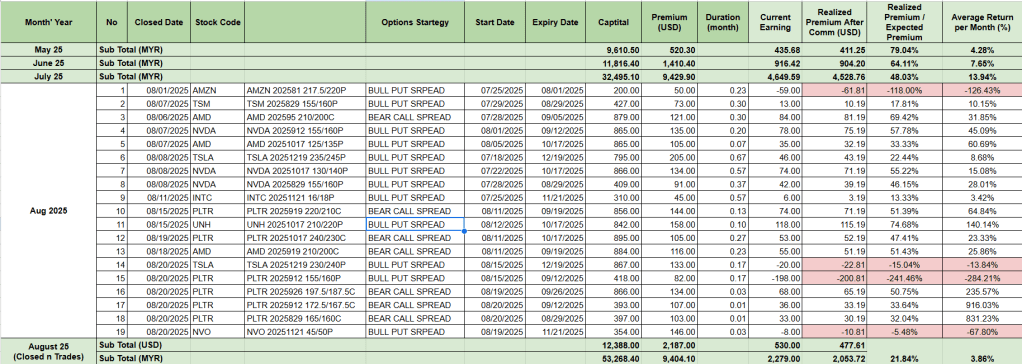
On August 20, 2025, in response to a cut-loss contract closure, I initiated additional trades to further reduce downside exposure.
Noticed the realisation of the premium increased fast during the quick drop of the underlying share. I close 3 sell call on the same day.
A quick summary on trades closed till the 3rd week of Aug’25:
19 trades closed till 3rd week of August’25
📝 Observations
Losses were contained – despite 2 forced cut-loss exits, overall win rate stayed strong at 84%.
Volatility management was key – sudden market drops forced earlier exits and additional hedging.
Short-duration spreads (some less than 5 days) worked well for quick profits (e.g., NVDA, PLTR).
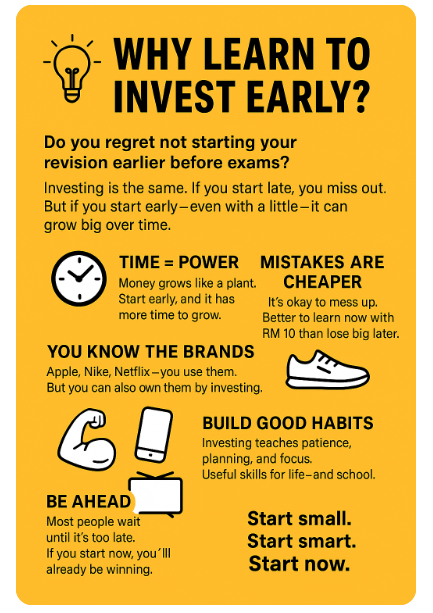
Do you ever regret not starting your revision earlier?
Like when exam results come out and everyone’s celebrating — but you’re stuck thinking, “If only I had started a bit sooner…”
Yeah. That feeling sucks.
But here’s the thing: exams can be retaken — life can’t.
If you start investing early, you’re giving yourself a huge head start. So when you graduate, even if your first job doesn’t pay a lot, you can still start planning for things like a car, a house, or a holiday.
Saving and investing now means less stress in the future — and more freedom to live the life you want. 💡💰
If you’re new to money management, it can be confusing to hear so many terms thrown around — saving, investing, trading. Aren’t they all about making money?
Yes… but they each work very differently.
In this post, I’ll walk you through the basics — using simple examples and clear language — to help you build the right habits from the start.
🐷 1. Saving – The Foundation
Saving means putting your money somewhere safe and easy to access. Most people start by saving in a piggy bank or a bank account.
💬 Saving is like collecting coins in a game and storing them in your backpack. You don’t use them yet — you’re just keeping them safe for later. No risk, no reward.
Why saving is important:
Helps you build discipline
Prepares you for emergencies
Supports short-term goals (like buying a phone or going on a trip)
💡 Saving is storing money safely, like in a bank saving account or piggy bank — no growth, but no danger.
🌱 2. Investing – Making Your Money Grow
Investing means putting your money into something that has the potential to grow over time — like stocks, ETFs, or even real estate. It’s okay, if you have no idea what are these.
💬 Investing is like spending your coins to build a base or upgrade your character over time. You don’t see the results right away, but if you keep upgrading slowly and wisely, your power level increases and pays off in the long run.
With investing:
Your money can increase in value
You can earn dividends or interest (extra money pay to you)
But there’s also a risk that it might go down in value too
Why investing matters:
It beats inflation (your money keeps up with rising prices)
It helps you build wealth for big goals (like education, house, or retirement)
The earlier you start, the more your money can grow (thanks to compounding!)
💡 Trading is trying to make quick gains by buying and selling often — like day trading or flipping crypto, shares and etc.
⚡ 3. Trading – The Fast Lane
ITrading is more like buying and selling quickly to take advantage of short-term price changes. This can happen in stocks, crypto, or options.
💬 Trading is like flipping rare items in the in-game market — you buy something when it’s cheap, hoping to sell it quick when demand goes up. It’s fast, exciting, but risky. If the trend changes, you might lose coins instead of gaining them.
With trading:
You can make money faster
But it’s riskier, and easy to lose money without a clear plan
It requires more time, focus, and emotional control
Why some people trade:
They enjoy market action
They want to profit from quick movements
But most successful traders learn through experience — and even losses
💡 Investing is putting your money into things that grow slowly over time — like stocks, funds, fixed deposits or ETFs.
🧠 Why Should Teens Start Early?
Even if you’re not ready to buy stocks or trade yet, this is the best time to learn. Why?
✅ You have time — and time is the most powerful tool in investing.
✅ You can start with small amounts — even RM10 or $10 saved regularly matters.
✅ You’re building smart habits that will stay with you for life.
The goal isn’t just to buy stocks right away. It’s about learning to save, protect your money, and eventually put it where it can grow.
💬 Imagine turning your pocket money into long-term value — not by luck, but by making smart choices early.
🔁 Start Small, Think Big
Whether you’re 14 or 18, starting now — even just by learning — will give you a huge advantage later. Don’t worry about being perfect. The key is to start with basic knowledge, good habits, and a long-term mindset.
“Image generated using Freepik AI tools and used in accordance with Freepik’s free license terms.”
📈 What Is a Put Option?
From the buyer point of view:
A Put Option gives you the right to sell 100 shares of a stock at a specific price (the strike price) before the expiration date.
You pay a premium upfront for this right.
❌ If the stock price stays above the strike price, you just let the option expire. Your maximum loss is the premium you paid.
✅ If the stock price goes below the strike price, you can exercise the option — and sell your shares at the higher strike price, making a profit.
A Put Option Seller (also called a put writer) agrees to buy the stock at the strike price if the buyer chooses to exercise the option.
In exchange, the seller receives the premium — this is their maximum profit.
❗ If the stock price crashes, the seller might be forced to buy shares at a much higher strike price, even though the market price is much lower. In short, the seller earns limited reward (premium) but takes on higher risk if the trade moves against them.
RISK!!!
Selling naked put options is risky if you’re not ready to buy the stock.
DON’T EVER SELL NAKED PUT OPTIONS!!! “Naked” means you’re selling the option without holding the shares or cash to cover it.
📦 One Option = 100 Shares
Remember!!! When you enter 1 Option contract, it represents 100 shares of a stock. So if the premium is $2, it means you pay or receive $2 × 100 = $200 premium as the buyer or seller respectively.
🎟 Simple Example
Let’s say:
A stock is trading at $50
You buy a Put Option with a $50 strike price
You pay a $3 premium → total cost: $3 × 100 = $300
Now two things can happen, the stock price can go up or down:
📈 Stock Stays Above $50
Buyer won’t execute the option
Buyer Loss = $300 premium paid
Seller Profit = $300 premium collected — no shares bought
Seller Loss = Must buy stock at $50 while market price is $40 → ($10 loss − $3 premium received) × 100 = −$700 (If the seller intends to buy share at this low target price, he / she will not mind buying the share at the low price, just need to ensure that you are selling put options for fundamentally good company)
💡 Why Use Put Options?
Protects your stock from falling prices (like insurance)
Lets you short a stock (profit from drops) with limited risk
Sellers can earn income while waiting to buy stocks they like-> ✅✅✅✅✅I personally sell put option for this purpose.
Buyers can secure a selling price even if the market crashes
“Image generated using Freepik AI tools and used in accordance with Freepik’s free license terms.”
📈 What Is a Call Option?
From the buyer point of view:
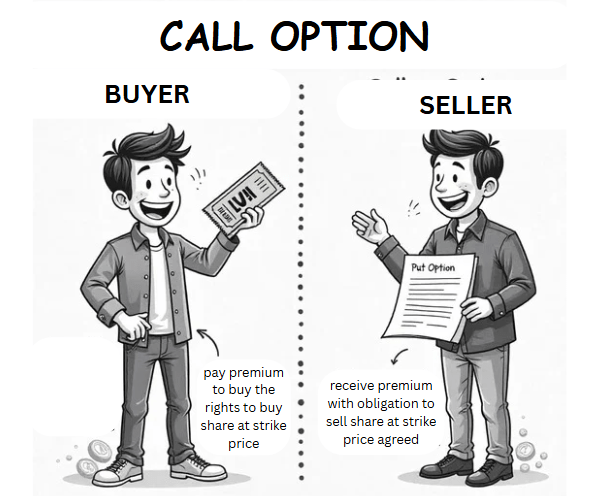
A Call Optionis like a ticket that gives you the right to buy a stock at a certain price (called the strike price) before a specific date.
You pay a small fee upfront (called a premium) to get this right. You don’t have to buy the stock — it’s your choice.
When there is a buyer, there must be a seller. From the seller point of view:
A Call Option seller (also called the option writer) is like someone offering a deal — they agree to sell a stock at a fixed price (strike price) if the buyer decides to use their option.
In return for taking on this obligation, the seller gets paid a small fee upfront, called a premium. This premium is the seller’s immediate income — and also their maximum profit from the contract.
But there’s a RISK:
If the stock price goes way above the strike price, the buyer might exercise the option, to buy 100 shares from the seller at the lower strike price agreed earlier. The seller must then sell the stock at the strike price — facing a loss if they don’t already own the shares, they need to buy the 100 shares from the market based on the market price and sell it to the buyer at the lower strike price agreed earlier.
In short, the seller earns limited reward (premium) but takes on higher risk if the trade moves against them.
DON’T EVER SELL NAKED CALL OPTIONS!!! “Naked” means you’re selling the option without holding the shares or cash to cover it.
However, you can still earn from a SELL CALL if you have pre-owned the 100 shares since long time ago that were bought at a price lower than a strike price.
📦 One Option = 100 Shares
Remember!!! When you enter one Option contract, it represents 100 shares of a stock. So if the premium is $2, the real cost of the contract is $2 × 100 = $200.
🎟 Simple Example
Let’s say:
You think a stock will go up – when you buy a call option, it means you are bullish about a stock.
The current price is $50, you can buy a call option that lets you buy the stock at $50 in the future if the stock price goes up (before the contract expiry date).
You pay a $2 premium x 100 = $200 for this rights.
Now two things can happen, the stock price can go up or down:
📈 Stock goes up to $60
Buyer will execute the option to buy at $50, then sell at $60 Profit: ($10 – $2 premium) x 100 shares = $8 x 100 = $800
Seller will sell 100 shares at $50 to the buyer Loss: ($50-$60+$2 premium) x 100 shares = -$8 x 100 = -$800
📉 Stock stays below $50
Buyer will not execute the option Loss: $2 premium x 100 = $200 premium paid earlier
Seller no need to sell share to the buyer Profit: $200 premium paid earlier received from the buyer earlier
💡 Why Use Call Options?
You don’t need to invest in 100 shares right away — the option lets you wait and see. If the price goes down, your only loss is the premium you paid, and you’re not required to buy the shares.
In the next post, I’ll explain the other type of option — the Put Option, which is about the right to sell instead of buy.
“Image generated using Freepik AI tools and used in accordance with Freepik’s free license terms.”
The word “option” means a choice — and that’s exactly what options trading is about.
The buyer pays for the right to make a choice later (to buy or sell a stock), while the seller agrees to fulfill whatever the buyer chooses — in return for a fee upfront called premium.
It’s Just Like Buying Insurance
Think of it this way:
When you buy insurance, you pay a premium to the insurance company. You might never make a claim, but if something bad happens, you can exercise your right and claim compensation.
The maximum loss for the buyer is the premium paid
The potential gain happens if the buyer decides to exercise the right at a profitable time.
For the seller (like the insurance company):
They receive the premium upfront, and that’s their maximum profit.
But if the buyer exercises their right (like claiming insurance), the seller has to cover the cost, which could be much more than the premium received.
Buyer of Option = Insurance Holder
Pays a premium
Has the right to buy/sell the stock
Limited loss (just the premium), but unlimited potential gain
Seller of Option = Insurance Company
Gets the premium upfront
Has the obligation to buy/sell the stock if buyer chooses
Limited gain (only the premium), but potential for large losses
📄 All Terms Are Written in a Contract
Just like an insurance policy, every option trade is defined by a contract. This contract includes:
The premium (the price the buyer pays)
The strike price (the fixed price at which the buyer can buy or sell the stock)
The expiry date (the deadline by which the buyer must decide)
Once the contract expires, the choice goes away. If the buyer doesn’t take action before then, the seller keeps the premium and nothing more happens.
There are two types of Options, i.e. Call (right to buy) and Put (right to sell). In my next post, and how traders use them to manage risk or generate income — just like how insurance works in everyday life.
As I mentioned, I couldn’t wait to start, and I jumped right in by selling puts to collect premium, and later, testing out a bull put spread.
Important Notes: Although I attempted to sell a PUT option in my first options trade, please NEVER NEVER NEVER SELL NAKED PUT (you must have the money to buy the 100 shares at the strike price in the worst case scenario). I sold this PUT option at a low strike price, intending to buy 100 shares if the price dropped. However, I expected the share price to rise, allowing me to profit from the premium collected.
Here are the details of the options contracts I placed:
1. $MARA – Sell Put(Closed Early for Profit)
Contract Type: Sell Put
Strike Price: $12.00
Stock Price (at entry): ~$14.00
Open Date: March 24, 2025
Close Date: May 9, 2025
Original Expiry: May 16, 2025
Premium Received: $89.00
Option Bought to Close: $0.12 ($12.00 total)
Commissions (Open & Close): $ 2.84 total
Net Profit After Commission: Premium Received – Option Bought to Close – Commissions ($89 – $12 – $ 2.84) = $74.16
This was my very first options contract. I sold the put with the hope of collecting the premium, and the trade played out nicely (I will buy the 100 shares at cheap price if the share price drops). The stock price stayed well above the $12 strike, so I closed the trade one week early at just $0.12. After deducting commissions, I walked away with a solid $72.74 profit.
It was a small but meaningful win — it helped build my confidence and confirmed that a simple strategy like selling puts can work when done with a plan.
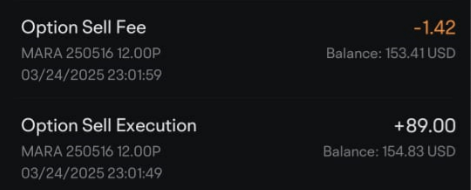
Screenshots are taken from the Fund Details page from Moomoo app:
The first screenshot shows that I sold MARA PUT option and received $89 premium by paying $1.42 commission.
The first screenshot shows that I buy back MARA PUT option to close it by paying $12 premium and $1.42 commission. And my net profit is $89 – $1.42 – $12 – $1.42 = $74.16
2. $SOXL – Sell Put(Closed Early for Small Profit)
Contract Type: Sell Put
Strike Price: $9.50
Stock Price (at entry): ~$13.20
Open Date: May 2, 2025
Close Date: May 12, 2025
Original Expiry: May 16, 2025
Premium Received: $17.00
Option Bought to Close: $0.02 ($2.00 total)
Commissions (Open & Close): $2.84
Net Profit After Commission: $12.16
A short-term trade that moved safely in my favor. With most of the premium collected and only $2 left on the table, I decided to close it early and lock in the profit. Another small step forward in learning how to manage exits.
3. $SOXL – Bull Put Spread(Expired with Full Profit)
Strategy: Bull Put Spread
Stock Price (at entry): ~$18.82
Trade Date: May 12, 2025
Expiry Date: May 30, 2025
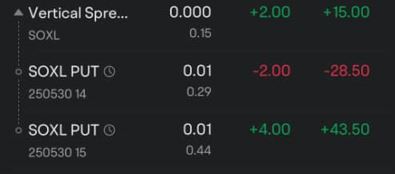
Leg 1 – Sell Put
Strike Price: $15.00
Premium Received: $44.00
Leg 2 – Buy Put
Strike Price: $14.00
Premium Paid: $29.00
Net Premium Collected: $15.00
Total Commission: $2.84
Net Profit After Commission: $12.16
This was my first spread strategy — and it worked out exactly how I hoped. The stock stayed above $15 through expiry, and I kept the full premium. Limiting risk while collecting income is something I’ll definitely keep exploring.
I managed to find a screenshot I took on 3rd Option Trade that has expired. The total gain from this vertical spread is $15.00 (Note: Bull Put Spread is on of the Vertical Spread Strategy).
Screenshot taken from the Moomoo app on the option’s expiry day
All three trades turned out positive — not massive wins, but safe, real, and encouraging. More importantly, I learned by doing:
Selling puts is a solid way to get started and generate income.
Closing early once most premium is collected helps avoid unnecessary risk.
Spreads give me confidence with limited risk when I want to trade closer to the stock price.
In the next post, I’ll break down how I selected these trades, what tools I used to analyze them, and what I plan to improve going forward.
I’m still new to investing — at least to what I’d call proper investing.
Previously, my so-called “strategy” was really just guesswork. I’d buy well-known stocks or look at random share price charts, by buying when the price dropped a lot and avoiding anything at an all-time high. No real plan. No structure. Just instincts.
That changed after I read a few books that opened my eyes to the many strategies out there — from capital gain plays to dividend-focused stocks to quant-style trading. Those books gave me a glimpse of what serious investing could look like, and that’s when I decided to treat this journey more seriously.
I also had a nudge from a friend who encouraged me to dedicate some time to investing and trading outside of my full-time job. That’s how we ended up spending a few mornings each week in a Family Mart, digging into strategies and trying to build a portfolio from scratch.
We didn’t manage to finish that portfolio — at least not the way we initially planned. Instead, we decided to get a head start by trying K2Robot trading by ChartNexus on the Tiger platform. It was a faster way to get our feet wet while continuing to learn. Each of us invested about 10k MYR (total up 4,6k USD into Tiger Plarform for a start in Mar2025).
Then came the Outlook 2025 event by Piranha Profits. I joined mainly because my friend invited me, but I left with a whole new level of motivation. One speaker in particular really caught my attention — a Vietnamese options trader who shared his story of going from extreme hardship after the war to becoming a multi-million-dollar options trader. His story, along with the appeal of high leverage in options trading compared to stocks, inspired me to sign up for an options trading course. I paid about USD 1,8k for the course and the journey started.
I’ll be honest — I couldn’t wait to start. Even before finishing the course, I jumped into options trading and made my first few trades. With the help of the learning materials available in Moomoo Trading App, I started to get a better grasp of how options trading works and began to understand a few key strategies. Slowly, things started to click — from basic calls and puts to more structured strategies, like vertical spread a start.
In my next post, I’ll share the details of the first three options contracts I bought [My First 3 Options Trade] — and how they turned out.






 Summarize It My Way