The Summary of Closed Trades (#1 – #9)

Before diving into the full summary, let’s have the quick update on Trade #8 & #9.

Trade #8: MARA– BULL PUT SPREAD (Expired with some loss of profit due to a mistake made)

  • Strategy: Bull Put Spread
  • Trade Placed: May 15, 2025
  • Original Expiry: June 13, 2025
  • Number of Contact: 1
  • Leg 1 – Buy Put
    • Strike Price: $0.12
    • Premium Paid: $11 per contract
  • Leg 2 – Sell Put
    • Strike Price: $0.35
    • Premium Received: $13 per contract
  • Total Commission: $2.84
  • Net Premium Received: ($35 – $12) – $2.84 = $20.16 (on expiry)

    I accidentally closed one the buy leg by buying back, I then resold one leg to re-establish back the bull-put spread strategy and waited till expiry. The original expected premium has been reduced to $14.74 instead of the original $20.16

    Trade #9: LYFT– BEAR CALL SPREAD (Expired with full profit)

    • Strategy: Bear Put Spread
    • Trade Placed: May 29, 2025
    • Original Expiry: June 13, 2025
    • Number of Contact: 1
    • Leg 1 – Buy Call
      • Strike Price: $16.50
      • Premium Paid: $11 per contract
    • Leg 2 – Sell Call
      • Strike Price: $17.50
      • Premium Received: $27 per contract
    • Total Commission: $2.84
    • Net Premium Received: ($27– $11) – $2.84 = $13.19 (on expiry)

    📊 Summary of Closed Trades (So Far – #1 – 9)

    So far, I’ve completed 9 trades using a mix of basic options strategies. Here’s a quick summary of what I’ve tested:

    ✅ Strategies Used:

    • Sell Put – to collect premium with the intention to buy at a lower price
    • Bull Put Spread – a more defined-risk strategy for bullish-to-neutral market
    • Bear Call Spread – a more defined-risk strategy for bearish-to-neutral market

    💰 Outcome (100% Win rate so far):

    All trades closed with small but positive profits, which is encouraging. While the gains aren’t huge, that’s completely fine.
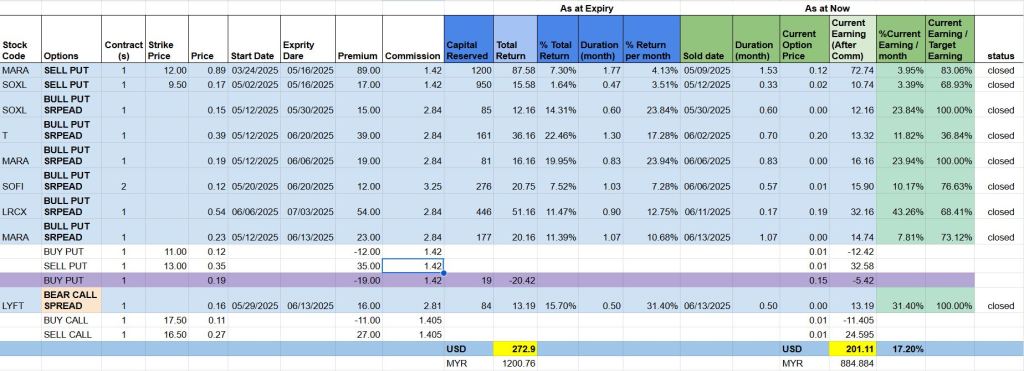
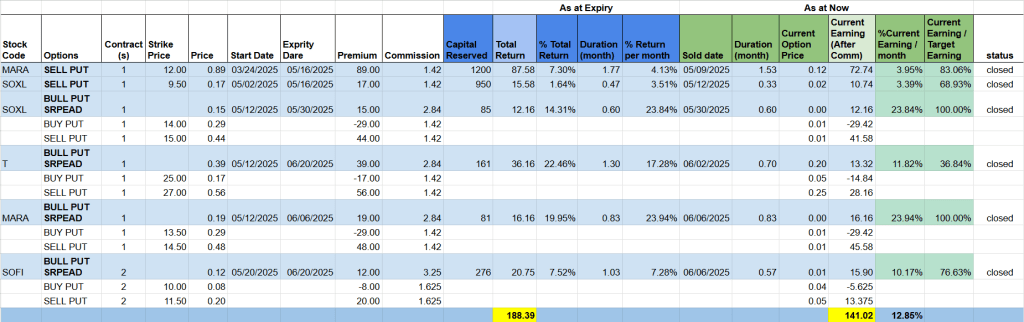
    Summary of the 9 contract closed so far (in USD): The second last column indicates the percentage of my expected target.

    Referring to the Staggered Expiry Dates mentioned in my earlier post [My New Options Routine: Targeting $100/Week with Weekly Expiries]. I buy contracts at different expiry to ensure there are weekly closures to generate some small income.
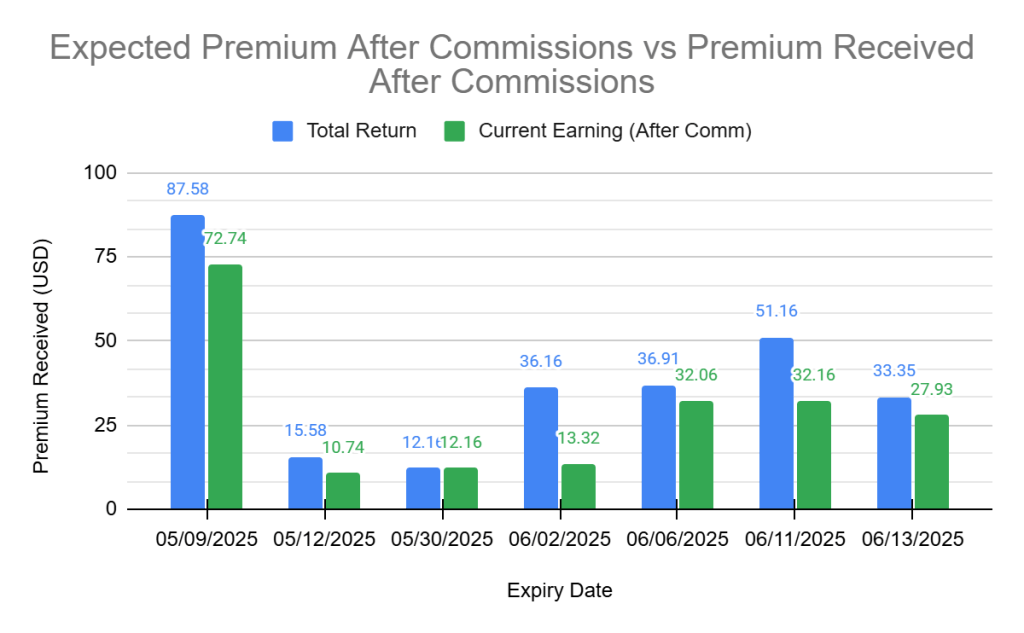
    The table above shows the expected premium received (blue bar) on Staggered Expiry Dates vs the actual premium received (green bar). If the green bar shows lower return than the blue bar, it means one or more contracts for that expected expiry date had been closed earlier. If the contract is expired with profits, both the bars will show same profit return.

    Note: one expiry date can have more than one contract.
    📈 My New Options Routine: Targeting $100/Week with Weekly Expiries

    After some time exploring the world of options trading, I’ve decided to implement a structured routine that helps me trade consistently and improve gradually — without overtrading or getting emotional. My current goal is simple:

    🎯 Close $100 in profit per week by buying options with staggered expiry dates — ensuring at least one contract expires each week.

    I’ll be updating this blog every weekend with my trade summary and reflections — wins, losses, and lessons included.

      Rules and Commitments for myself:

      Staggered Expiry Dates
      Ensures I am not overexposed to one expiration week. It spreads out risk and keeps a consistent flow of activity.

      Weekly Closing Goal
      Targeting $100 per week is realistic for small accounts (e.g., $2k–$5k capital). It forces discipline and avoid overtrading.

      Routine Structure
      Having specific days for screening, buying, monitoring, and reviewing reduces emotional decision-making.

      Built-in Reflection & Adjustment
      Weekly blogging/logging for self-review, for improving.

      🛠 Tools I’m Using

      TypeTool NameUsage Description
      Charting & AnalysisChartNexusFor technical analysis, drawing setups
      Broker PlatformMoomoo App
      *Tiger Trade (for bot trading only)
      For placing trades, reviewing option chains, and managing open positions
      Trade LoggingGoogle SheetsTo log each trade’s entry/exit, profit/loss, notes, and track weekly performance (on Options only)
      Reflection & SharingThis Blog (running on WordPress)To document weekly results, track progress, reflect strategy used
      Back testing Strategy Moomoo Desktop App, Own Built Python scriptsTo backtest simple strategies
      Performance GraphingGoogle Sheets, Tableau Public (Free Version – https://public.tableau.com)For documenting backtest result
      Performance CreationCanva – https://www.canva.com
      Freepik – https://www.freepik.com/
      For image creation to use in blogs

        Final Thoughts

        This routine is my attempt to turn trading into a weekly ‘business‘, not a random gamble. It’s a mix of structure, learning, and personal growth — and I’ll share everything I learn, whether it’s a win or a tough loss.

        If you’re building a routine of your own, feel free to follow along or share your approach. Let’s grow together.

        Until next weekend —
        Stay consistent. Stay curious. Trade small.

        The Summary of Closed Trades (#1 – #7)

        Before diving into the full summary, let’s have the quick update on Trade #7.

        Trade #7: LRCX – BULL PUT SPREAD (Closed early in 5 days instead of 21 days after realizing more than 68% of the expected Profit)

        • Strategy: Bull Put Spread
        • Trade Placed: June 6, 2025
        • Original Expiry: July 3, 2025
        • Number of Contact: 1
        • Leg 1 – Buy Put
          • Strike Price: $74
          • Premium Paid: $35 per contract
        • Leg 2 – Sell Put
          • Strike Price: $79
          • Premium Received: $89 per contract
        • Total Commission: $3.25
        • Net Premium Received: ($89 – $35) – $2.84 = $51.16 (on expiry)

        I closed it earlier by selling and buying back the BUY PUT and SELL PUT respectively

        • Closed Early: June 11, 2025
        • Leg 1 – Buy Put
          • Sell at $0.16 option price by receiving $16
        • Leg 2 – Sell Put
          • Buy at $0.35 option price by paying $35
        • Total Commission: $2.84
        • Net Premium Paid: ($16 – $35) – $2.85 = -$21.84

        Hence, instead of earning the full $36.16 on expiry, I took a small gain by paying back $22.84 to close the option contract. The net gain is $51.16 – $21.84= $29.32


        📊 Summary of Closed Trades (So Far – #1 – 7)

        So far, I’ve completed 7 trades using a mix of basic options strategies. Here’s a quick summary of what I’ve tested:

        ✅ Strategies Used:

        • Sell Put – to collect premium with the intention to buy at a lower price
        • Bull Put Spread – a more defined-risk strategy for bullish-to-neutral market

        💰 Outcome:

        All trades closed with small but positive profits, which is encouraging. While the gains aren’t huge, that’s completely fine — I treat this as a learning and experimentation phase, not a race to big profits.

        The goal is to understand how different strategies behave, how the market responds, and how to manage risk — before scaling up.

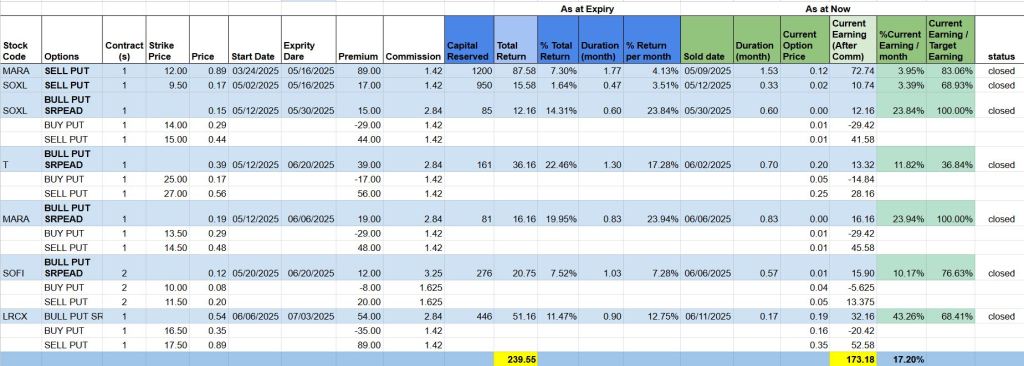
        Summary of the 7 contract closed so far (in USD):
        The second last column indicates the percentage of my expected target. (Note: If I am very confident that the price will stay below my strike till expiry, i will wait till its expiry. And for some, I will just close as long as some profit is made)

        I

        A Simple Way to Generate Income for Beginner

        A friend sent me a screenshot of the WHEEL strategy yesterday. It reminds me to share this in blog.

        Funny thing is, I had already thought of this approach on my own before realizing it was actually a real, practical strategy. I only found out its name and how it’s used after reading about it in a training material on the Moomoo app.

        Today, I want to share what I’ve learned about the WHEEL strategy. The WHEEL strategy is a systematic options approach that involves two key actions:

        Step-by-Step: How It Works

        Step 1: Sell a Cash-Secured Put

        I begin by choosing a stock I wouldn’t mind owning 100 shares of. Then I sell a put option at a strike price I’m comfortable buying at. I keep the premium upfront. For example, I sell 1 put option contract for Google for 2 months at strike price USD150.

        If the stock price stays above the strike price by expiration, I keep the premium and repeat.

        If the price drops below the strike, I buy 100 shares at the strike price (which I planned for).

        NOTE: secured put means you need to own the money to buy the 100 shares in case the price dropped to the target price you set.

        Step 2: Sell a Covered Call

        Now that I own 100 shares bought at the very low price from Step 1, I sell a covered call at a higher strike price, i.e USD 200.

        If the stock rises above the strike price, my shares are sold, and I keep the profit + premium.

        If not, I still own the shares and can repeat the process of selling more calls for income.

        And once the shares are sold, I go back to step 1: sell puts again. That’s why it’s called the “WHEEL” — it keeps turning.


        Why I Like This Strategy

        • Simple to understand for non-professionals
        • Generates consistent premium income
        • Lets me accumulate stocks at discounted prices

        Things to Keep in Mind

        • Choose high-quality stocks you don’t mind holding
        • Ensure you have enough capital to buy 100 shares if assigned

        I’m currently trying to use this method in my own investing journey. It allows me to stay active in the market, collect income, and potentially accumulate stocks I believe in — all while following a simple, repeatable system.

        At this stage, I am still collecting premium while waiting for the share price to drop to my target.

        Have you tried the WHEEL strategy before? Let me know your experience or thoughts in the comments!


        The Summary of Closed Trades (#1 – #6)

        Before diving into the full summary, let’s have the quick update on Trade #5 and #6.

        Trade #5: SOFI – BULL PUT SPREAD (Closed Early for Small Profit)

        • Strategy: Bull Put Spread
        • Trade Placed: May 20, 2025
        • Original Expiry: June 20, 2025
        • Number of Contact: 2
        • Leg 1 – Buy Put
          • Strike Price: $10
          • Premium Paid: $8 per contract
        • Leg 2 – Sell Put
          • Strike Price: $11.5
          • Premium Received: $20 per contract
        • Total Commission: $3.25
        • Net Premium Received: ($20 – $8) * 2 – $3.25 = $20.75 (on expiry)

        I closed it earlier by selling and buying back the BUY PUT and SELL PUT respectively

        • Closed Early: June 6, 2025
        • Leg 1 – Buy Put
          • Sell at $0.04 option price by receiving $4
        • Leg 2 – Sell Put
          • Buy at $0.25 option price by paying $5
        • Total Commission: $2.85
        • Net Premium Paid: ($4 – $5) x 2 – $2.85 = -$4.85

        Hence, instead of earning the full $36.16 on expiry, I took a small gain by paying back $22.84 to close the option contract. The net gain is $20.75 – $4.85 = $15.90


        Trade #6: MARA– Bull Put Spread (Expired with Full Profit)

        • Strategy: Bull Put Spread
        • Stock Price (at entry): ~$16.70
        • Trade Date: May 12, 2025
        • Expiry Date: June 6, 2025
        • Leg 1 – Sell Put
          • Strike Price: $13.50
          • Premium Received: $48.00
        • Leg 2 – Buy Put
          • Strike Price: $14.50
          • Premium Paid: $29.00
        • Net Premium Collected$19.00
        • Total Commission: $2.84
        • Net Profit After Commission$16.16

        The stock stayed above the strike price through expiry, and I kept the full premium.


        📊 Summary of Closed Trades (So Far – #1 – 6)

        So far, I’ve completed 6 trades using a mix of basic options strategies. Here’s a quick summary of what I’ve tested:

        ✅ Strategies Used:

        • Sell Put – to collect premium with the intention to buy at a lower price
        • Bull Put Spread – a more defined-risk strategy for bullish-to-neutral market

        💰 Outcome:

        All trades closed with small but positive profits, which is encouraging. While the gains aren’t huge, that’s completely fine — I treat this as a learning and experimentation phase, not a race to big profits.

        The goal is to understand how different strategies behave, how the market responds, and how to manage risk — before scaling up.

        Summary of the 6 contract closed so far (in USD):
        The second last column indicates the percentage of my expected target. (Note: If I am very confident that the price will stay below my strike till expiry, i will wait till its expiry. And for some, I will just close as long as some profit is made)

        Testing Out K2Robot on Tiger Trade – Our Experiment

        As part of our trading journey, a friend and I decided to try out the K2Robot on the Tiger Trade platform. We share this account purely for learning and experimenting — not to chase big profits, but to observe how an automated strategy performs in real market conditions.

        If you’ve ever wondered, “How well does K2Robot actually perform?” — let me share what we’ve experienced so far.

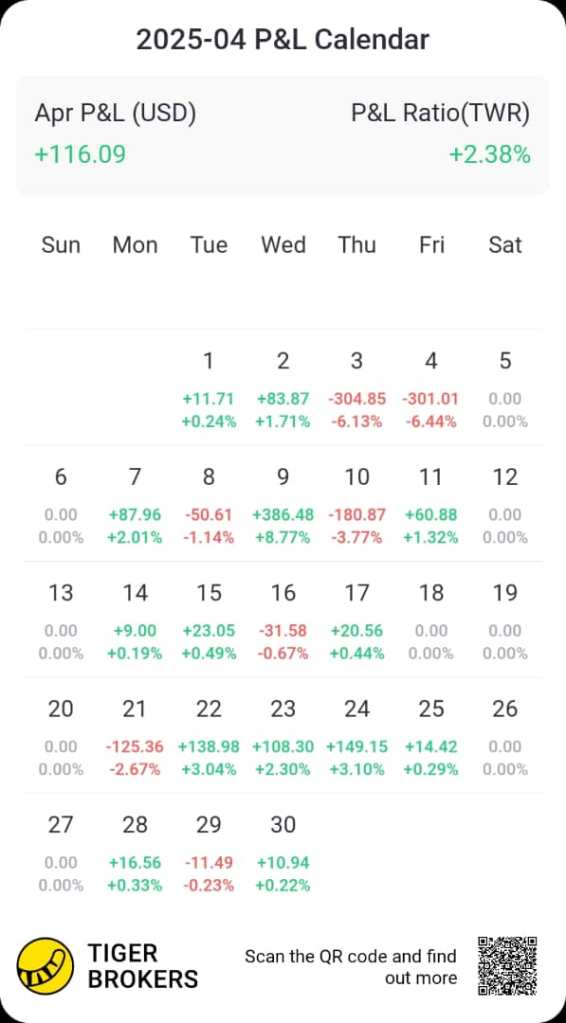
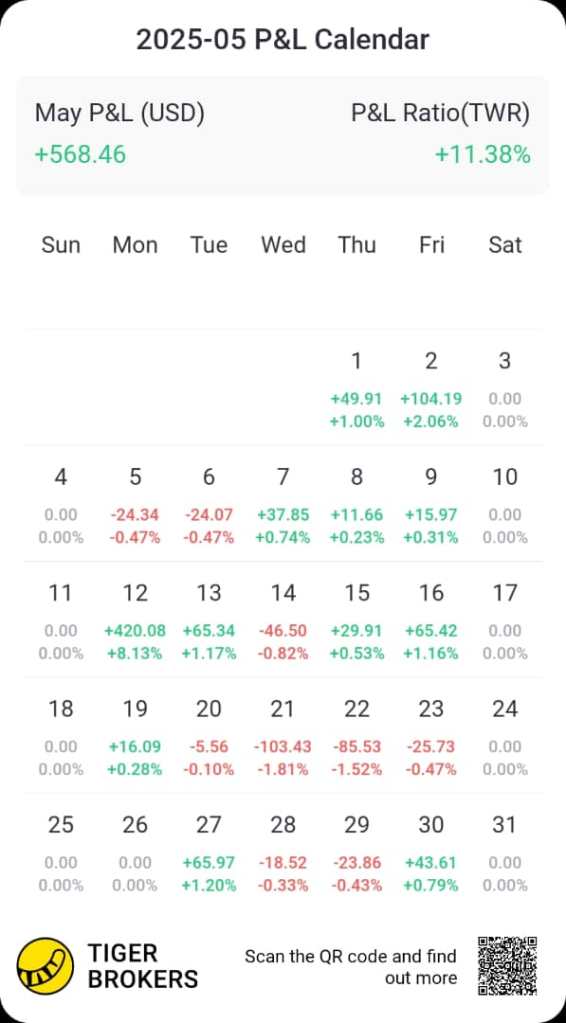
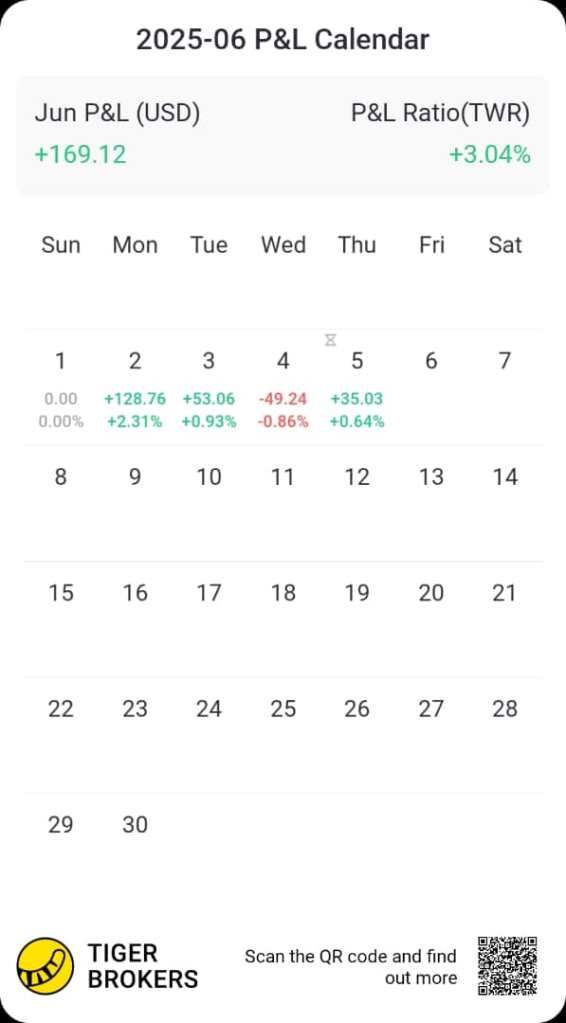
        From how it picked the trades to how it handled market ups and downs, here’s an honest look at our results and thoughts. (Note: The account was created in early year 2024, it took us a while to figure out why no trade was place till early March 2024.

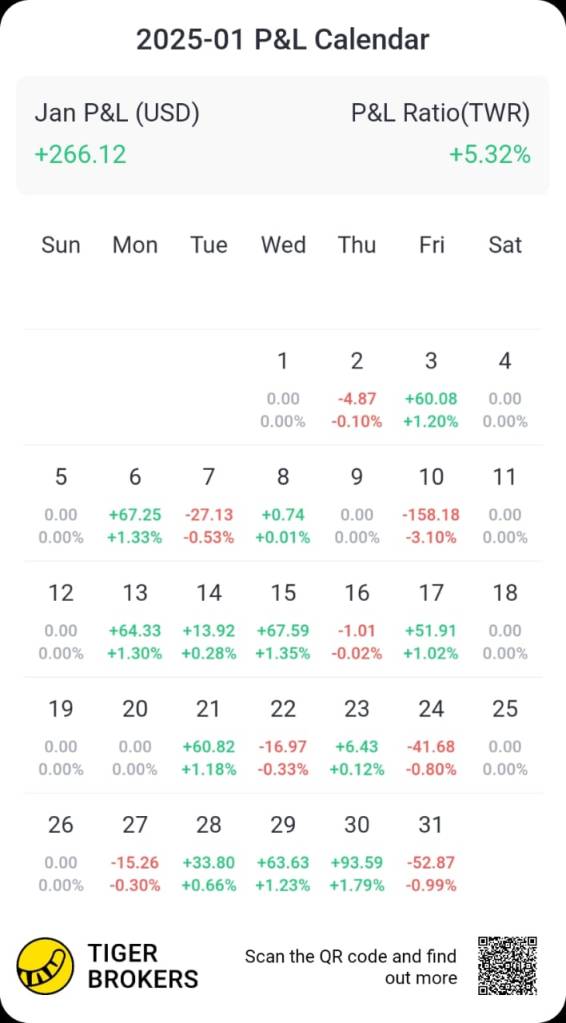
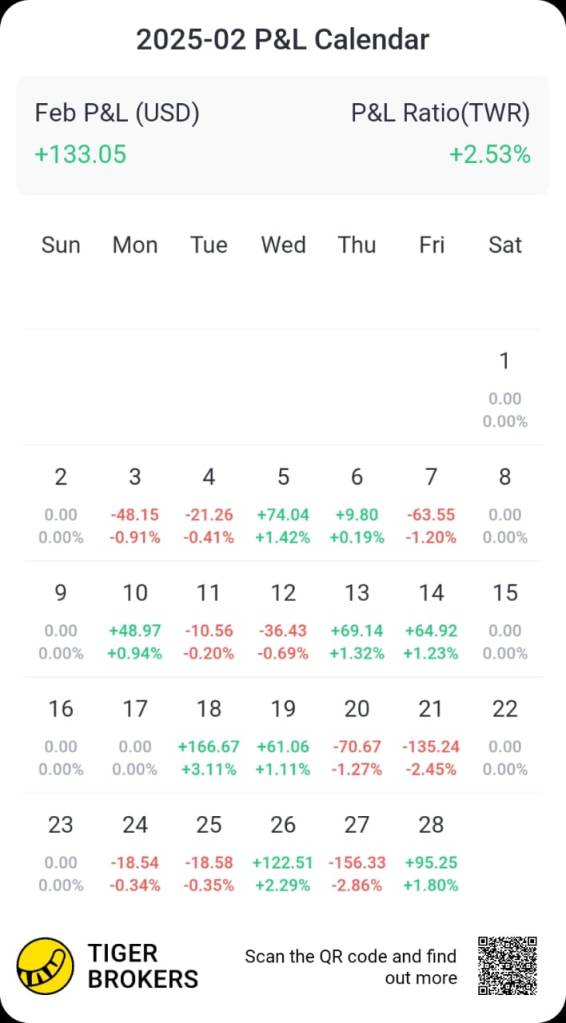
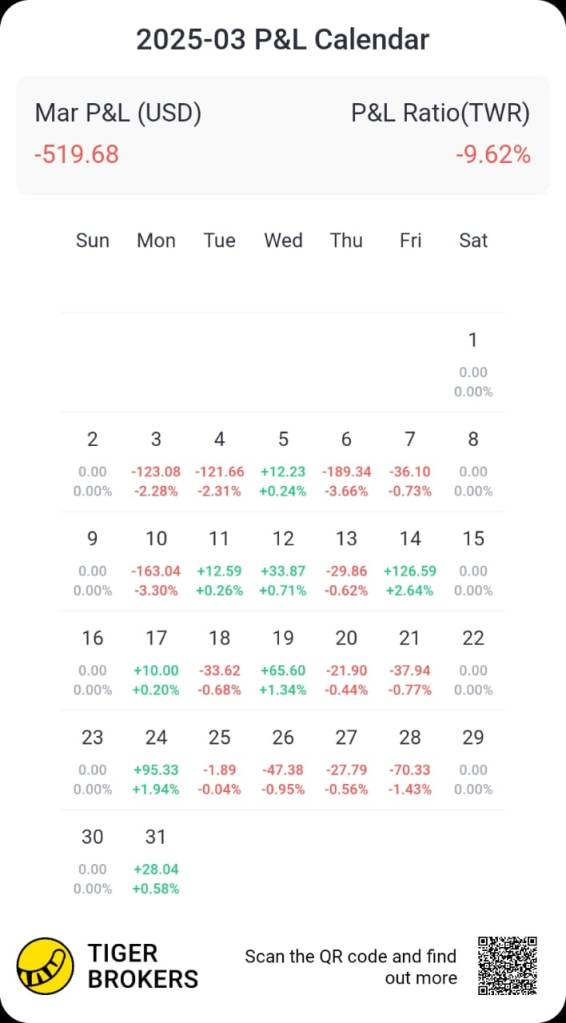
        Below is the monthly P&L for Year 2025 (I uploaded these screenshots on 5th June 2025 and hence the P&L for June only shows up till 5th June during US pre-market time.

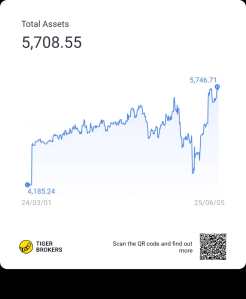
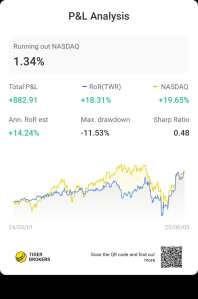
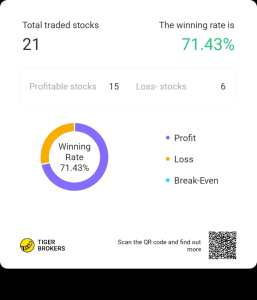
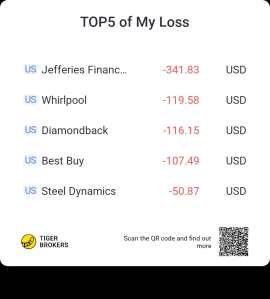
        The overall performance from day 1 till today (about 1 year 2 months):

        Total Asset Since Day 1
        Robot P&L vs NASDAQ
        Transaction Summary
        Winning Rate
        Top 5 Profit
        Top 5 Loss

        If you’d like to find out more or have any questions about our experience, feel free to leave a comment below!

        CALL OPTION – About the Chart and How to Choose Buy or Sell Call Option from the Trading App

        Visualizing the Call Option with a Simple Profit/Loss Chart

        To make things clearer, let’s look at a simple profit-loss chart for both the buyer and seller of a call option. This helps show how each position behaves as the stock price changes. I have taken some screenshots from the trading app today. Let me also touch a bit on how to choose buy or sell put option from the Moomoo app.

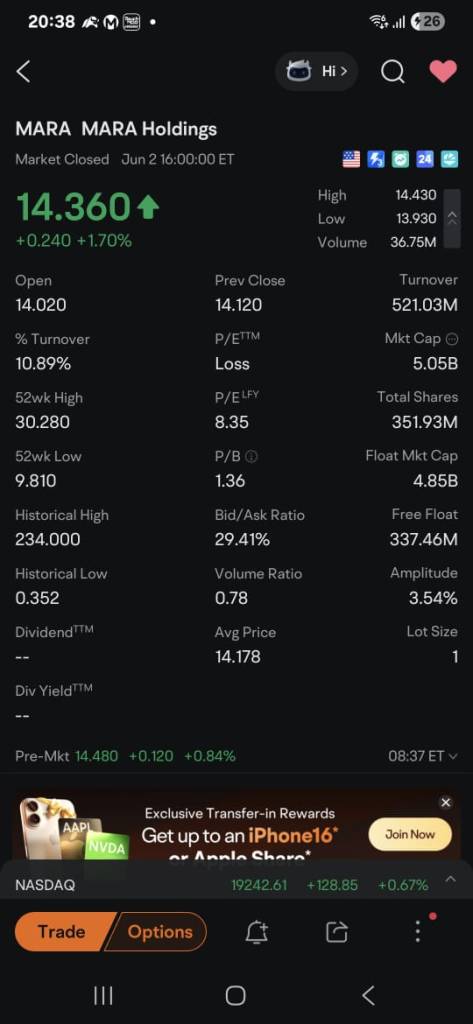
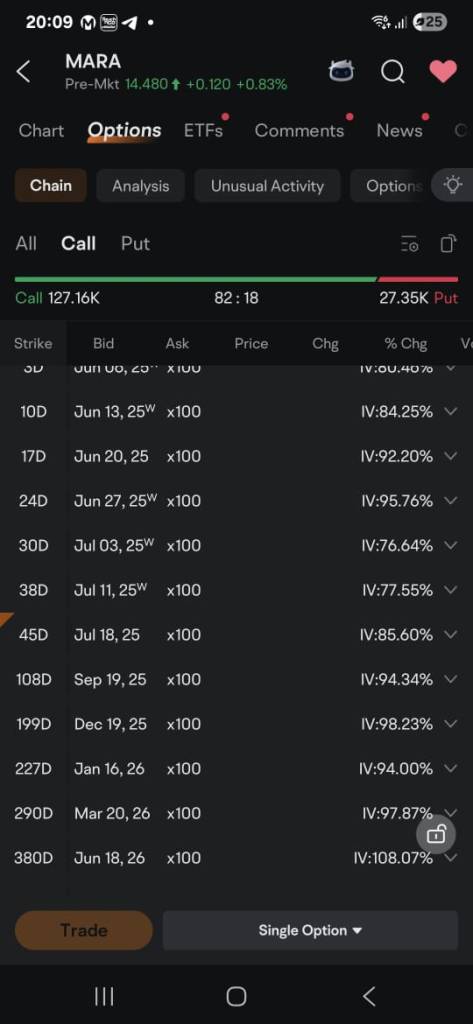
        1. First, search for the stock. I use MARA as an example here.
        2. Click on Option button at the bottom of the page. Click in call to focus only on the chain data for call option. [Screenshot 1]
        3. Select the expiry date, I choose 45 days for this example.[Screenshot 2]
          Note: for buyer, always choose expiry more than 30 days because the option price will usually drop fast when the contract has less than 30 days close to expiry
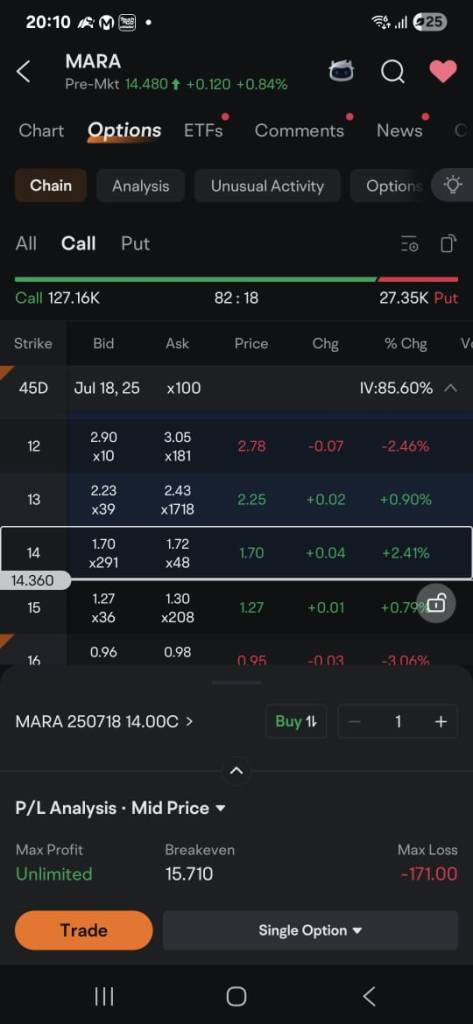
        4. Buying a call option means you are bullish about the stock. Place the strike price near the current price ($14.36). I choose $14 as the strike price in this example.
          Note:
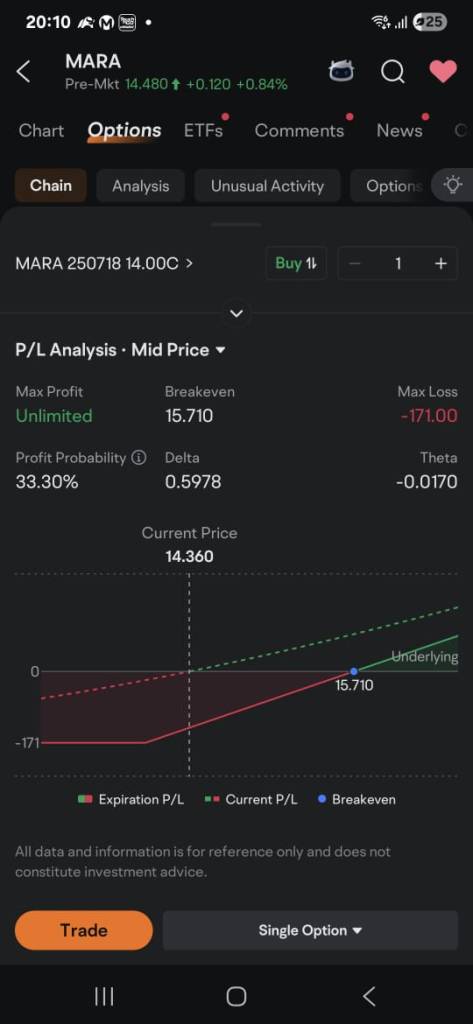
          • The buyer hopes the price will go up by expiry and he may exercise the option by buying 100 shares at the strike price, the profit can be unlimited depending on how high the share price can go.
          • In case the price goes lower than the strike price, you will not want to buy the shares and you will loss the total premium you paid.
        5. Since you are the buyer, look for the ask price (the price seller is willing to offer to sell). [Screenshot 3]
        6. Ask Price (or the mid price) $1.71 x 100 shares is the total premium you need to pay. This is the maximum loss for the buyer.
        Screenshot 1
        Screenshot 2
        Screenshot 3

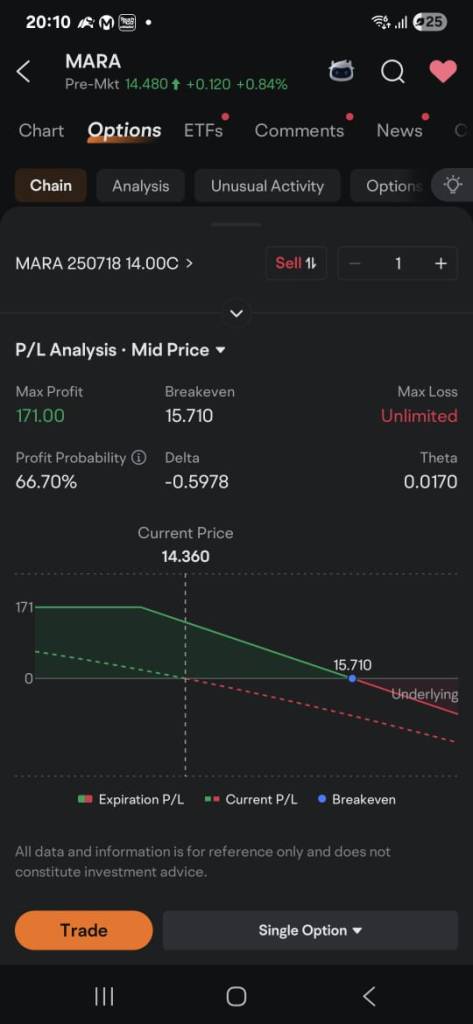
        The seller at the same time is bearish about the stock, he receives premium from the buyer ($1.71 x 100 shares = $171 premium)

        If the share price falls below the strike price, the buyer will not exercise his rights to buy shares. In this case, the premium will be the maximum profit made by the seller.

        However, if the share price goes up and buyer wants to exercise his rights to buy share at the strike price, the seller needs to buy 100 shares at the market price and sell it at $14 per share to the buyer. The seller will have unlimited loss depending on how high the share price can go.

        Below is the profit / loss chart for both the buyer and seller. They are exact opposites of each other. Take awhile to look at the max profit and max loss.

        Buy Call
        Sell Call

        The breakeven:

        The buyer don’t start making profit immediately when the share price goes a little above the strike price. Don’t forget about the premium paid ($1.17), this needs to be included in the profit/loss calculation. So, the buyer will only earn when the price goes higher than $14 (strike price) + $1.71 (premium) = $15.71. This is the breakeven.

        The same breakeven is applicable to the seller in the opposite way because seller receives premium from the buyer. The seller will start losing when the share price goes below $15.71 (not when it goes lower than the strike price which us $14 in this case)

        I Closed the 4th Option Trade Yesterday

        Before diving into my 4th trade, I’ve made a small update to my previous post about My First 3 Otions trades — I’ve added some screenshots to make things clearer. Feel free to check it out if you’d like to see how those trades looked in the app!

        📈 Trade #4: AT&T – BULL PUT SPREAD (Closed Early for Small Profit)

        For my fourth trade, I opened a bull put spread on AT&T:

        • Strategy: Bull Put Spread
        • Stock Price (at entry): ~$27.42
        • Trade Placed: May 12, 2025
        • Original Expiry: June 20, 2025
        • Total Commission: $2.84
        • Net Premium Received: $39 – $2.84 = $36.16 (on expiry)

        I closed it earlier by selling and buying back the BUY PUT and SELL PUT respectively

        • Closed Early: June 2, 2025
        • Leg 1 – Buy Put
          • Sell at $0.05 option price by receiving $5
        • Leg 2 – Sell Put
          • Buy at $0.25 option price by paying $25
        • Total Commission: $2.84
        • Net Premium Paid: $5 – $25 – $2.84 = -$22.84

        Hence, instead of earning the full $36.16 on expiry, I took a small gain by paying back $22.84 to close the option contract. The net gain is $36.16 – $22.84 = $13.32

        It’s really a small gain but okay, I am gaining the experience here.

        Just Me, Figuring Things Out

        A Little Note About Me and This Blog

        Everything I share here is based on what I’ve read, learned, and personally tried. It’s a mix of trial, error, small wins, and lessons along the way. I’m not a professional trader or financial expert — just someone who’s genuinely curious and trying to make sense of the investment world step by step.

        I hope to learn from fellow investors and traders out there. Whether you’re a beginner like me or someone with more experience, I’d love to hear your thoughts, feedback, or even just a hello.

        I started this blog as a way to document what I’ve explored, especially in trading and investing. But to be honest, I’m still figuring out how to structure things properly. The blog might feel a little messy, dull, or hard to navigate right now — I feel it too. So if you’ve landed here and have any suggestions, I’d really appreciate your thoughts on how I can improve.

        Also, I don’t have any social media connected to this blog yet — I’m still new to the blogging space and slowly finding my way.

        Thanks for dropping by. I hope you find something useful or relatable here, and if not — I’m still grateful you took the time. 😊

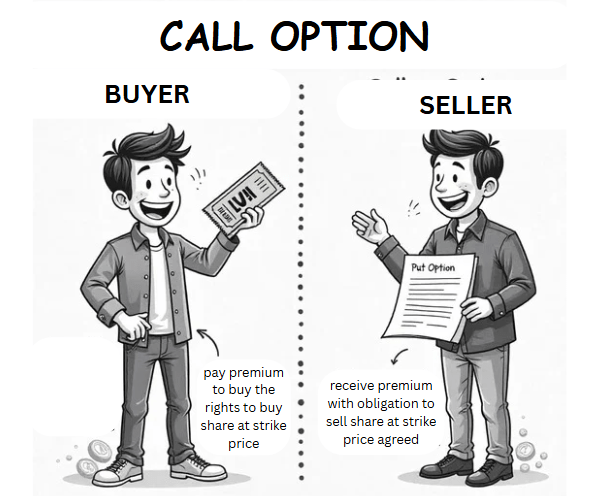
        CALL OPTION

        “Image generated using Freepik AI tools and used in accordance with Freepik’s free license terms.”

        📈 What Is a Call Option?

        From the buyer point of view:

        A Call Option is like a ticket that gives you the right to buy a stock at a certain price (called the strike price) before a specific date.

        You pay a small fee upfront (called a premium) to get this right. You don’t have to buy the stock — it’s your choice.


        When there is a buyer, there must be a seller. From the seller point of view:

        A Call Option seller (also called the option writer) is like someone offering a deal — they agree to sell a stock at a fixed price (strike price) if the buyer decides to use their option.

        In return for taking on this obligation, the seller gets paid a small fee upfront, called a premium. This premium is the seller’s immediate income — and also their maximum profit from the contract.

        But there’s a RISK:

        If the stock price goes way above the strike price, the buyer might exercise the option, to buy 100 shares from the seller at the lower strike price agreed earlier. The seller must then sell the stock at the strike price — facing a loss if they don’t already own the shares, they need to buy the 100 shares from the market based on the market price and sell it to the buyer at the lower strike price agreed earlier.

        In short, the seller earns limited reward (premium) but takes on higher risk if the trade moves against them.

        However, you can still earn from a SELL CALL if you have pre-owned the 100 shares since long time ago that were bought at a price lower than a strike price.


        Remember!!! When you enter one Option contract, it represents 100 shares of a stock. So if the premium is $2, the real cost of the contract is $2 × 100 = $200.


        🎟 Simple Example

        Let’s say:

        • You think a stock will go up – when you buy a call option, it means you are bullish about a stock.
        • The current price is $50, you can buy a call option that lets you buy the stock at $50 in the future if the stock price goes up (before the contract expiry date).
        • You pay a $2 premium x 100 = $200 for this rights.

        Now two things can happen, the stock price can go up or down:

        📈 Stock goes up to $60

        Buyer will execute the option to buy at $50, then sell at $60
        Profit: ($10 – $2 premium) x 100 shares = $8 x 100 = $800

        Seller will sell 100 shares at $50 to the buyer
        Loss: ($50-$60+$2 premium) x 100 shares = -$8 x 100 = -$800

        📉 Stock stays below $50

        Buyer will not execute the option
        Loss: $2 premium x 100 = $200 premium paid earlier

        Seller no need to sell share to the buyer
        Profit: $200 premium paid earlier received from the buyer earlier


        💡 Why Use Call Options?

        You don’t need to invest in 100 shares right away — the option lets you wait and see. If the price goes down, your only loss is the premium you paid, and you’re not required to buy the shares.


        In the next post, I’ll explain the other type of option — the Put Option, which is about the right to sell instead of buy.