“Image generated using Freepik AI tools and used in accordance with Freepik’s free license terms.”
The word “option” means a choice — and that’s exactly what options trading is about.
The buyer pays for the right to make a choice later (to buy or sell a stock), while the seller agrees to fulfill whatever the buyer chooses — in return for a fee upfront called premium.
It’s Just Like Buying Insurance
Think of it this way:
When you buy insurance, you pay a premium to the insurance company. You might never make a claim, but if something bad happens, you can exercise your right and claim compensation.
The maximum loss for the buyer is the premium paid
The potential gain happens if the buyer decides to exercise the right at a profitable time.
For the seller (like the insurance company):
They receive the premium upfront, and that’s their maximum profit.
But if the buyer exercises their right (like claiming insurance), the seller has to cover the cost, which could be much more than the premium received.
Buyer of Option = Insurance Holder
Pays a premium
Has the right to buy/sell the stock
Limited loss (just the premium), but unlimited potential gain
Seller of Option = Insurance Company
Gets the premium upfront
Has the obligation to buy/sell the stock if buyer chooses
Limited gain (only the premium), but potential for large losses
📄 All Terms Are Written in a Contract
Just like an insurance policy, every option trade is defined by a contract. This contract includes:
The premium (the price the buyer pays)
The strike price (the fixed price at which the buyer can buy or sell the stock)
The expiry date (the deadline by which the buyer must decide)
Once the contract expires, the choice goes away. If the buyer doesn’t take action before then, the seller keeps the premium and nothing more happens.
There are two types of Options, i.e. Call (right to buy) and Put (right to sell). In my next post, and how traders use them to manage risk or generate income — just like how insurance works in everyday life.
As I mentioned, I couldn’t wait to start, and I jumped right in by selling puts to collect premium, and later, testing out a bull put spread.
Important Notes: Although I attempted to sell a PUT option in my first options trade, please NEVER NEVER NEVER SELL NAKED PUT (you must have the money to buy the 100 shares at the strike price in the worst case scenario). I sold this PUT option at a low strike price, intending to buy 100 shares if the price dropped. However, I expected the share price to rise, allowing me to profit from the premium collected.
Here are the details of the options contracts I placed:
1. $MARA – Sell Put(Closed Early for Profit)
Contract Type: Sell Put
Strike Price: $12.00
Stock Price (at entry): ~$14.00
Open Date: March 24, 2025
Close Date: May 9, 2025
Original Expiry: May 16, 2025
Premium Received: $89.00
Option Bought to Close: $0.12 ($12.00 total)
Commissions (Open & Close): $ 2.84 total
Net Profit After Commission: Premium Received – Option Bought to Close – Commissions ($89 – $12 – $ 2.84) = $74.16
This was my very first options contract. I sold the put with the hope of collecting the premium, and the trade played out nicely (I will buy the 100 shares at cheap price if the share price drops). The stock price stayed well above the $12 strike, so I closed the trade one week early at just $0.12. After deducting commissions, I walked away with a solid $72.74 profit.
It was a small but meaningful win — it helped build my confidence and confirmed that a simple strategy like selling puts can work when done with a plan.
Screenshots are taken from the Fund Details page from Moomoo app:
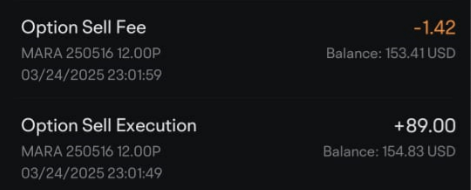
The first screenshot shows that I sold MARA PUT option and received $89 premium by paying $1.42 commission.
The first screenshot shows that I buy back MARA PUT option to close it by paying $12 premium and $1.42 commission. And my net profit is $89 – $1.42 – $12 – $1.42 = $74.16
2. $SOXL – Sell Put(Closed Early for Small Profit)
Contract Type: Sell Put
Strike Price: $9.50
Stock Price (at entry): ~$13.20
Open Date: May 2, 2025
Close Date: May 12, 2025
Original Expiry: May 16, 2025
Premium Received: $17.00
Option Bought to Close: $0.02 ($2.00 total)
Commissions (Open & Close): $2.84
Net Profit After Commission: $12.16
A short-term trade that moved safely in my favor. With most of the premium collected and only $2 left on the table, I decided to close it early and lock in the profit. Another small step forward in learning how to manage exits.
3. $SOXL – Bull Put Spread(Expired with Full Profit)
Strategy: Bull Put Spread
Stock Price (at entry): ~$18.82
Trade Date: May 12, 2025
Expiry Date: May 30, 2025
Leg 1 – Sell Put
Strike Price: $15.00
Premium Received: $44.00
Leg 2 – Buy Put
Strike Price: $14.00
Premium Paid: $29.00
Net Premium Collected: $15.00
Total Commission: $2.84
Net Profit After Commission: $12.16
This was my first spread strategy — and it worked out exactly how I hoped. The stock stayed above $15 through expiry, and I kept the full premium. Limiting risk while collecting income is something I’ll definitely keep exploring.
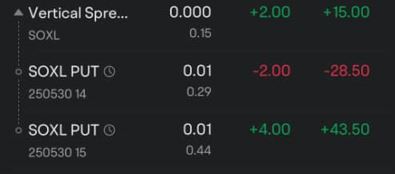
I managed to find a screenshot I took on 3rd Option Trade that has expired. The total gain from this vertical spread is $15.00 (Note: Bull Put Spread is on of the Vertical Spread Strategy).
Screenshot taken from the Moomoo app on the option’s expiry day
All three trades turned out positive — not massive wins, but safe, real, and encouraging. More importantly, I learned by doing:
Selling puts is a solid way to get started and generate income.
Closing early once most premium is collected helps avoid unnecessary risk.
Spreads give me confidence with limited risk when I want to trade closer to the stock price.
In the next post, I’ll break down how I selected these trades, what tools I used to analyze them, and what I plan to improve going forward.
I’m still new to investing — at least to what I’d call proper investing.
Previously, my so-called “strategy” was really just guesswork. I’d buy well-known stocks or look at random share price charts, by buying when the price dropped a lot and avoiding anything at an all-time high. No real plan. No structure. Just instincts.
That changed after I read a few books that opened my eyes to the many strategies out there — from capital gain plays to dividend-focused stocks to quant-style trading. Those books gave me a glimpse of what serious investing could look like, and that’s when I decided to treat this journey more seriously.
I also had a nudge from a friend who encouraged me to dedicate some time to investing and trading outside of my full-time job. That’s how we ended up spending a few mornings each week in a Family Mart, digging into strategies and trying to build a portfolio from scratch.
We didn’t manage to finish that portfolio — at least not the way we initially planned. Instead, we decided to get a head start by trying K2Robot trading by ChartNexus on the Tiger platform. It was a faster way to get our feet wet while continuing to learn. Each of us invested about 10k MYR (total up 4,6k USD into Tiger Plarform for a start in Mar2025).
Then came the Outlook 2025 event by Piranha Profits. I joined mainly because my friend invited me, but I left with a whole new level of motivation. One speaker in particular really caught my attention — a Vietnamese options trader who shared his story of going from extreme hardship after the war to becoming a multi-million-dollar options trader. His story, along with the appeal of high leverage in options trading compared to stocks, inspired me to sign up for an options trading course. I paid about USD 1,8k for the course and the journey started.
I’ll be honest — I couldn’t wait to start. Even before finishing the course, I jumped into options trading and made my first few trades. With the help of the learning materials available in Moomoo Trading App, I started to get a better grasp of how options trading works and began to understand a few key strategies. Slowly, things started to click — from basic calls and puts to more structured strategies, like vertical spread a start.
In my next post, I’ll share the details of the first three options contracts I bought [My First 3 Options Trade] — and how they turned out.
As a full-time employee working in a bank, time and energy are often in short supply. Yet, I’ve always felt the need to explore new ways to generate a second source of income. With the rising cost of living and inflation impacting daily life, simply adjusting my lifestyle to cope is not an option I’m willing to consider.
For years, I’ve wanted to embark on this trading and investment journey, but something always held me back. Recently, I realized that delaying this any further would only mean missing out on opportunities to secure a better financial future. With determination and a desire to take control of my financial goals, I decided it was time to start—no matter the constraints.
What I’ve Explored So Far
Balancing work and learning hasn’t been easy, but I’ve made progress by diving into various resources to build my foundation. Here’s what I’ve explored:
Books: I’ve read several books that teach the basics of investment and trading, offering a variety of strategies shared by different authors. These have been invaluable for understanding the fundamentals and developing a structured approach.
Free Talks and Webinars: While the information shared is often limited and geared towards convincing attendees to enroll in paid courses or follow specific strategies, they can still be valuable. For me, I join these sessions to pick up new ideas or identify areas I might not know about and then dive deeper through self-study.
Paid Courses: To take things a step further, I’ve invested in paid courses. These programs provide in-depth knowledge on various topics.
Each resource has been a stepping stone, helping me build the skills to navigate this new territory.
My Current Experiments
Learning by doing has been a crucial part of my journey. Here’s what I’ve started experimenting with:
Tiger Platform Paid Bot: I’ve subscribed to a paid bot on the Tiger platform since Mar 2024, which automates trading strategies. This allows me to observe how these strategies play out in real time and learn from their performance. Check this out from my trading bot post!!
Strategy Testing on MooMoo: I’ve also begun testing strategies I learnt on the MooMoo platform since Jun 2024. Applying what I’ve learned in real market conditions helps me understand both the strengths and limitations of different approaches.
What’s Coming Next
This blog is the beginning of a journey I’m eager to share. In future posts, I’ll document everything I learn—from insights gained through books and courses to the successes and failures of my hands-on experiments. My aim is to create a realistic picture of what it’s like to pursue trading and investing as a busy full-time employee.
If you’re also navigating similar challenges or thinking about starting your own journey, let’s connect. Together, we can learn, grow, and find ways to achieve financial independence. Stay tuned for more updates in the coming posts!



 Summarize It My Way